

Enhancing VA Healthcare IT
Enhancing VA Healthcare IT Through Secure, Event-Driven Enterprise Integration
For more than a decade, Supporting Effort has supported the Department of Veterans Affairs (VA) in delivering operational healthcare modernization across cloud engineering, interoperability, DevSecOps, observability, and mission-critical Veteran systems. As the VA modernizes toward cloud-native and event-driven enterprise architectures, the focus is shifting from isolated applications toward operational capability platforms that can synchronize real-time clinical, scheduling, facility, staffing, logistics, and patient care activities across the enterprise. One of the most important examples of this evolution is the VA Scheduling Event Bus — a scalable, secure, and highly available operational integration layer that transforms disconnected scheduling and operational activities into coordinated enterprise healthcare operations.
This is not simply a technology modernization effort or another integration project. It is an operational capability that directly impacts Veteran outcomes, enterprise coordination, clinical responsiveness, and the synchronization of healthcare delivery across the VA ecosystem.
When Seconds Matter, Coordination Matters More
Consider a real-world operational scenario:
A 68-year-old Veteran arrives at the Viera VA Clinic in Melbourne, Florida, experiencing symptoms of acute coronary syndrome (NSTEMI). Within minutes, clinical staff initiates ECG diagnostics, laboratory testing, oxygen therapy, medication administration, and emergency transfer coordination to the Orlando VA Medical Center at Lake Nona for emergent intervention and CABG surgery.
Behind every one of those clinical activities exists a series of scheduling, operational, staffing, facility, equipment, pharmacy, transport, and care coordination events that today often traverse multiple disconnected systems, manual coordination processes, spreadsheets, phone calls, and isolated application workflows.
The Scheduling Event Bus changes this operational model by converting healthcare activities into standardized, secure, real-time enterprise events that can be published, subscribed to, monitored, governed, replayed, audited, and operationally synchronized across VA systems.
In this scenario, the event bus would capture and distribute operational events such as:
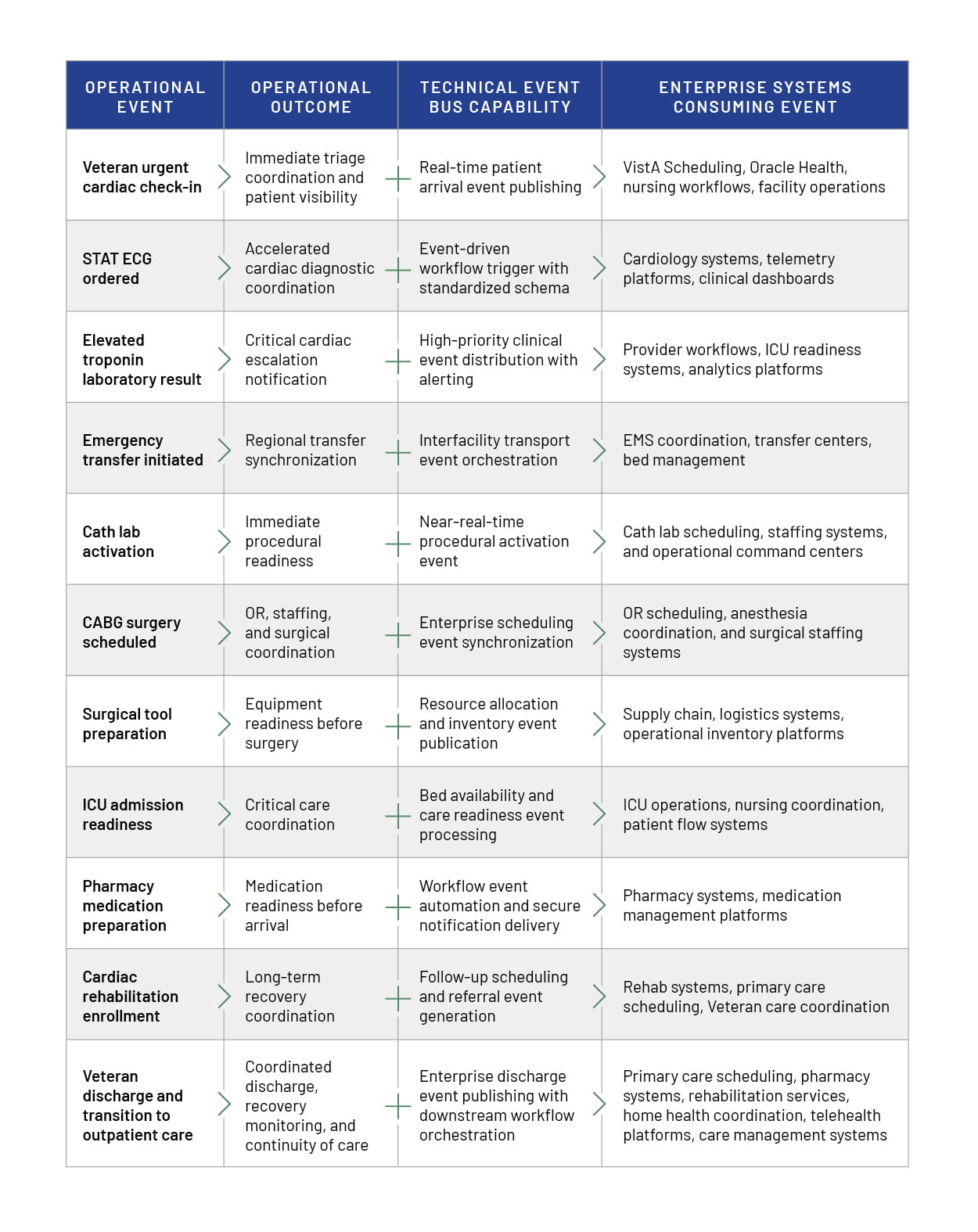
Rather than relying on manual coordination and disconnected workflows, the Scheduling Event Bus enables enterprise operational synchronization across the VA ecosystem and with authorized Community Care providers outside the VA environment. Systems such as VistA Scheduling, Enterprise Appointment Service, VA Online Scheduling (VAOS), Virtual Care Manager, VA Video Connect, telehealth platforms, pharmacy systems, patient flow coordination systems, Community Care coordination services, and downstream analytics platforms can securely subscribe to operational events in real time while remaining loosely coupled from originating systems.
From Isolated Applications to an Enterprise Coordination Layer
The Scheduling Event Bus also establishes a modernization pathway for existing VA applications and shared services to securely publish, consume, and operationally synchronize enterprise scheduling and clinical workflow events. Existing scheduling, mobile health, telehealth, patient coordination, appointment management, notification, and clinical workflow services can be progressively integrated into the event-driven architecture through standardized onboarding patterns, reusable integration services, and governed event contracts.
For example:
- Cardiac escalation events immediately alert downstream cardiology teams
- Facility systems identify available ICU beds and critical equipment
- Surgical scheduling systems coordinate OR readiness and staffing
- Supply chain systems validate surgical tools and inventory availability
- Pharmacy systems prepare medications before patient arrival
- Rehabilitation and follow-up coordination begin before discharge
This creates a true operational healthcare coordination layer instead of a collection of disconnected healthcare applications.

Operational Resilience When the Healthcare System Is Under Pressure
The operational value of the Scheduling Event Bus becomes increasingly important during surge conditions, regional emergencies, and periods of high patient volume, where scalability, interoperability, resilience, and operational synchronization directly impact Veteran care delivery.
Key capabilities include:
- Real-time event publishing and subscription
- Standardized event schemas and message contracts
- Loose coupling between systems to reduce integration risk
- Durable messaging, replay capability, automated failover, and fault tolerance
- Enterprise observability and monitoring across event flow and system health
- Secure identity-based access controls and RMF-aligned audit logging
- Horizontal scalability for growing enterprise transaction volumes
- Governed onboarding processes, reusable integration standards, and migration patterns for future VA systems and shared services
Most importantly, this modernization approach supports the future of enterprise healthcare operations where scheduling, staffing, logistics, patient coordination, and clinical workflows operate from a shared operational awareness model.
The Scheduling Event Bus is much more than middleware infrastructure. It is a foundational operational capability that helps the VA move from fragmented coordination toward synchronized enterprise healthcare operations that improve responsiveness, operational efficiency, and Veteran outcomes.