

AI Solutions
AI Solutions for Federal Government Missions
Artificial intelligence presents a significant opportunity across federal agencies—but its implementation must reflect mission context. The same underlying technology that supports a soldier in a denied, degraded, intermittent, and low-bandwidth (DDIL) environment must also serve an older Veteran navigating benefits from a tablet at the kitchen table. The stakes are high in both cases. The conditions couldn’t be more different.
Mission Context Drives Architecture
Picture a forward-deployed Army unit in a DDIL environment. The AI assistant they depend on must run offline, synchronize when bandwidth becomes available, and function under strict compute and security constraints. The architecture must prioritize deterministic workflows, minimal model footprint, secure synchronization, and resilient state management. Responses must be fast, reliable, and operationally precise. Failure is not inconvenience—it is mission impact.
Now picture an 83-year-old Veteran trying to access his benefits from home. He earned those benefits, but the process is overwhelming. The AI assistant supporting him must translate complex policies into plain language, accurately capture structured information, and reduce confusion or anxiety. The architecture must prioritize accessibility, auditability, and integration with enterprise case systems. If the system fails him, the Veteran doesn’t retry—he walks away from benefits he’s owed. In this scenario, clarity, simplicity, and guided support build trust.
In both cases:
- Enterprise systems—not the AI—control state transitions and policy enforcement.
- AI services handle natural language understanding, structured extraction, and explanation.
- Human oversight remains embedded in the process.
- Every interaction is auditable and traceable.
The approaches diverge in implementation. For DDIL deployments, this means deterministic state machines, edge-capable inference strategies, secure synchronization protocols, and strict resource constraints.
For enterprise service delivery, it means citation-based knowledge retrieval, secure session management, structured data capture, and compliance-ready logging.
The governing principle remains the same: AI augments operations within defined authority boundaries.

Both scenarios require AI. But the design priorities fundamentally differ—and the architecture must reflect that.
A Unified, Governed Approach
While the mission contexts vary, our methodology adapts to both environments by separating conversational intelligence from workflow authority.
Agile Delivery Aligned to Operational Reality
We deliver AI capabilities in focused increments shaped by the mission, not by a one-size-fits-all roadmap.
For tactical or constrained environments, early sprints establish secure edge architecture, offline workflows, and synchronization patterns before expanding AI functionality.
For service delivery environments, early increments focus on guided workflows, structured intake, and knowledge grounding before expanding automation.
In both cases, development includes prompt version control, regression testing, security validation, and operational metrics. We measure what matters: performance, containment rates, escalation frequency, and user comprehension.
Why Our Approach Works
A Soldier operating in DDIL conditions and a Veteran navigating benefits represent different ends of the mission spectrum, but both require disciplined engineering, governance, and human-centered design.
Our approach ensures:
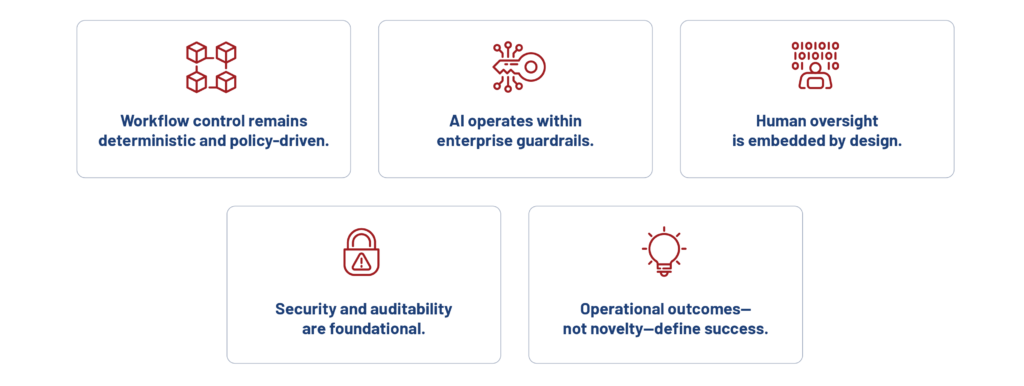
By tailoring architecture to mission context while maintaining consistent governance principles, we help federal agencies deploy AI securely and responsibly—whether at the tactical edge or in enterprise service delivery.