

DeliveryIQ: Turning AI Efficiency into Measurable Mission Value
An Illustrative My HealtheVet Course-of-Action Example
Artificial intelligence can accelerate requirements analysis, user-research synthesis, architecture, code, testing, cybersecurity evidence, documentation, release preparation, and incident analysis. Those gains matter, but activity volume is not mission value. A change becomes valuable only when qualified people review it, VA accepts it, users can rely on it, and quality, security, accessibility, and production performance remain equal or better.
Supporting Effort’s DeliveryIQ creates an evidence chain between AI-enabled work and VA-accepted outcomes. It establishes a baseline, applies AI and automation across the software delivery lifecycle, measures every sprint, and evaluates sustained performance at a 90-day Program Increment (PI) gate. It does not assume a universal productivity multiplier or predetermine a staffing reduction. It gives VA evidence to choose between two valid courses of action (COA): lower future cost or use the same capacity to deliver more mission value.
My HealtheVet (MHV) is a useful illustration because it is a mature, mission-critical digital-health ecosystem that must operate and improve without disrupting Veterans’ access. Full-stack teams must protect secure messaging, medications, medical records, health tools, integrations, cybersecurity, accessibility, and service reliability while advancing modernization. In this environment, speed matters only when accepted outcomes and operational safeguards move together.
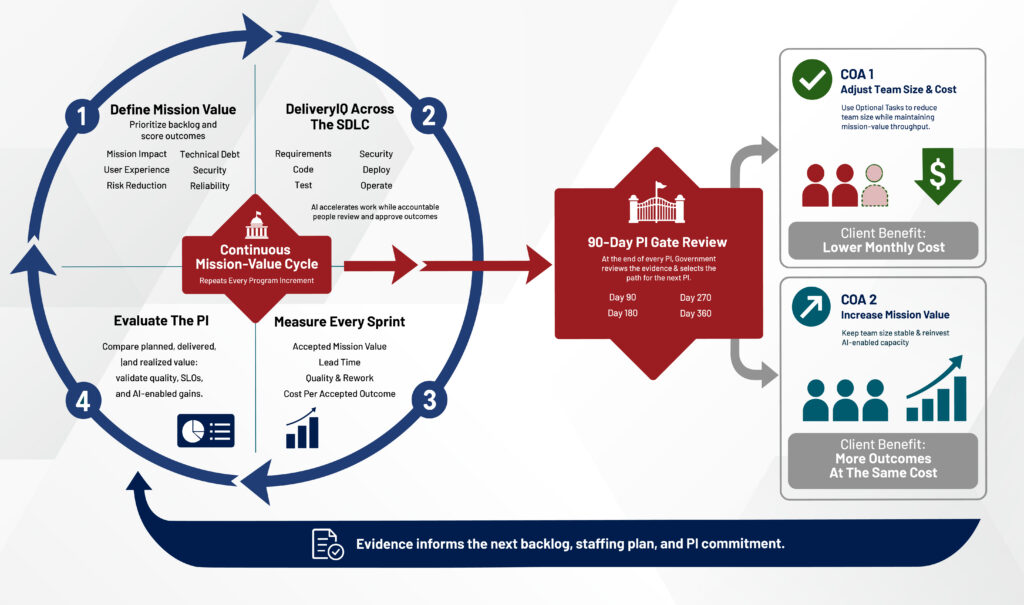
Figure 1. DeliveryIQ converts sprint-level evidence into a VA choice at each 90-day Program Increment gate.
Measure Every Sprint: Decide Every 90 Days
At PI planning, VA and the delivery teams define outcome-bearing work and expected measures: Veteran and user impact, accepted mission value, lead time, quality and rework, security and accessibility, reliability and service levels, human review effort, and cost per accepted outcome. DeliveryIQ accelerates bounded work, but people remain accountable for decisions, approvals, and production results.
A VA-visible Value Ledger records planned and accepted value, human and AI effort, corrections, rejected outputs, test and security results, service performance, and total cost. At the gate, VA compares planned, delivered, and realized value. Only repeated, production-supported improvement counts; no efficiency credit is earned if defects, incidents, VA review burden, or operational risk increase.
Illustrative MHV COA 1: Three Teams Become Two
Assume VA assigns three large, optional MHV product-delivery teams for the first 90-day PI to accelerate a high-priority modernization backlog. This is an illustrative packaging of optional capacity, not a claim that the MHV PWS prescribes three teams. Core operations and accountable product coverage continue throughout the increment.
At Day 90, the evidence shows accepted mission value is on or above target; lead time and rework improved; quality, security, accessibility, and service levels remained stable or improved; and cost per accepted outcome declined. The Value Ledger also demonstrates that two DeliveryIQ-enabled teams can sustain the required productivity and coverage for the next PI.
VA then selects COA 1: reduce future optional capacity from three large teams to two. The objective is not headcount reduction for its own sake. It is the same or greater VA-accepted productivity at a lower monthly cost, with no hidden transfer of work or risk. The decision remains reversible: VA can restore capacity at a later PI if workload, mission priorities, or performance change.
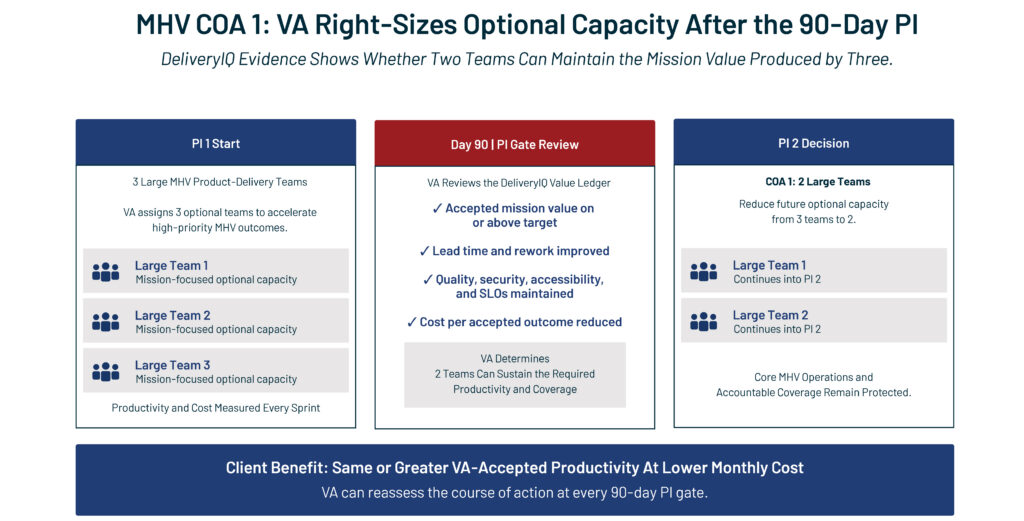
Figure 2. Illustrative MHV COA 1: after the first 90-day PI, VA reduces future optional capacity from three large teams to two only when evidence shows the same or greater VA-accepted productivity can be maintained.
DeliveryIQ turns AI efficiency into a governed VA choice rather than an unsupported productivity claim. VA can see what three teams delivered, what two can sustain, and whether savings remain real after accounting for human review, quality, security, operations, and acceptance. When the evidence supports it, VA can lower future optional cost with confidence; when mission demand is higher, VA can retain capacity and pursue additional outcomes. VA controls the decision, and DeliveryIQ supplies the evidence.