

The Next CRM Chapter for VA
Building on the VA Health Connect Experience
VA Health Connect offers a practical precedent for the next customer relationship management (CRM) modernization effort at VA. It modernized Veteran access to clinical, scheduling, pharmacy, and administrative assistance. The VA Health Connect project successfully consolidated more than 80 contact centers into 18 regional hubs running on a single Salesforce implementation, providing a foundation for approaching the broader enterprise challenge of contact center consolidation.
Supporting Effort personnel supported integration, testing, release readiness, stakeholder coordination, adoption, and sustainment across VA Health Connect and related VA Salesforce programs. That work reinforced a central lesson: VA cannot modernize the Veteran experience through technology alone; it must also improve how employees coordinate and deliver services.
The opportunity is not simply to move more applications onto Salesforce. It is to make VA easier for Veterans to navigate while helping employees resolve their needs.
Different Programs. A Connected Veteran Experience.
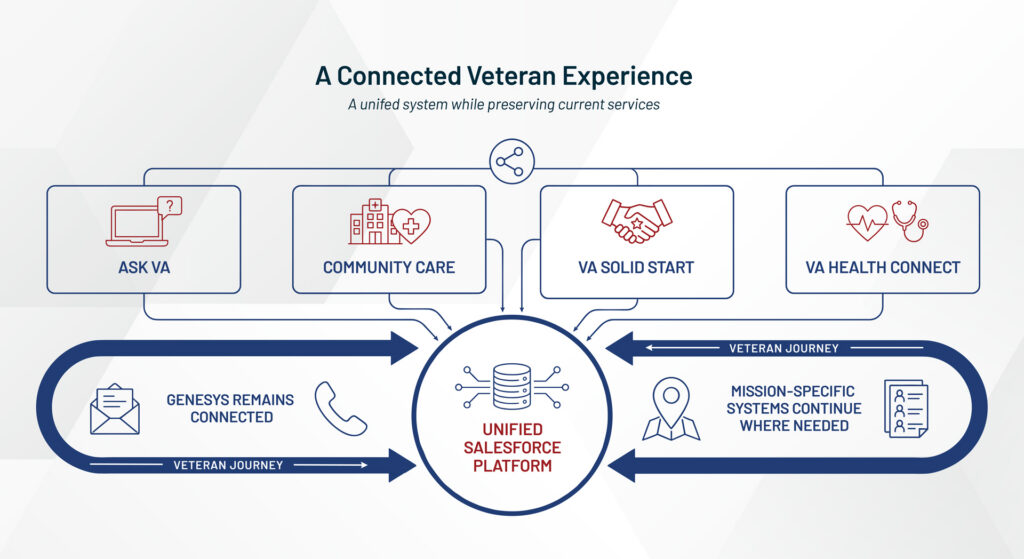
VA is exploring how to bring together the contact center CRM systems used by programs such as AskVA, Community Care, VA Solid Start, and VA Health Connect, ensuring that existing systems will keep running while VA builds a more unified Salesforce environment.
Consider an illustrative Veteran journey: a recently separated service member receives Solid Start outreach, seeks help enrolling in VA health care, and later asks about a Community Care referral. These are separate program responsibilities, but they are parts of one person’s experience.
Consolidation within a single Salesforce application will help authorized employees access relevant context, understand who owns the next action, and support follow-through. It should not force Veterans to navigate organizational boundaries or require every program to use an identical workflow.
Standardize What Is Common. Preserve What the Mission Requires.
Supporting Effort recommends one enterprise CRM strategy and a common Salesforce ecosystem with shared capabilities including Veteran identity, knowledge, intake, routing, integration, security, and reporting. Mission-specific applications or separate Salesforce organizations may remain where clinical, benefits, privacy, availability, or other operational requirements justify them. The goal is to eliminate unnecessary duplication without eliminating necessary customization.
That approach begins with AI helping the team collect and organize information about the existing CRM applications used across VA, including their call types, entities, business rules, data, integrations, and active cases. Working within VA-authorized environments, the team will use AI to review documentation and system configurations, build a common application inventory, compare workflows, identify duplication, and map dependencies between systems. VA and CRM experts will validate the findings and use that evidence to decide what to retain, modernize, consolidate, re-platform, or retire. The team will then migrate systems in controlled waves based on readiness, supported by user validation, data reconciliation, deployment rehearsals, rollback planning, and post-launch stabilization, all while ensuring that existing services continue operating.

Use AI to Create Measurable Choices
Supporting Effort’s DeliveryIQ, our AI-enabled framework for accelerating the full technology delivery lifecycle, provides the framework for accelerating CRM modernization delivery. Within VA-authorized environments, the proposed approach will help teams analyze configurations, compare workflows, prepare data mappings, generate tests, and develop role-specific training. AI-generated artifacts will remain unverified drafts until qualified personnel review them, with security, accessibility, testing, and VA release controls still required.
DeliveryIQ’s proposed management model measures progress every sprint and evaluates evidence at a 90-day checkpoint. VA will review accepted mission value, delivery time, quality, rework, reliability, and cost per accepted outcome. Demonstrated efficiencies will create two choices: reduce cost while maintaining mission-value delivery, or maintain investment and deliver more value. Neither outcome should be assumed before the evidence supports it.
For CRM modernization, those measures should connect delivery performance to operational results: completed workflows, avoidable transfers, case quality, employee proficiency, and service health. The financial assessment should include licensing, migration, integration, parallel operations, sustainment, and legacy retirement, rather than contractor headcount alone.
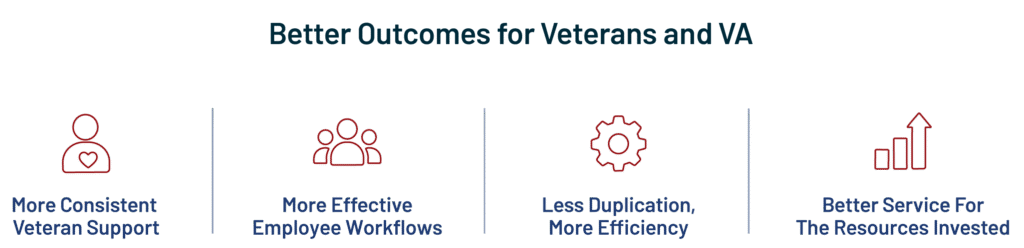
The measure of success is not how many contact center CRMs migrate to Salesforce. It is whether Veterans receive more consistent help through a more positive experience, whether employees can complete their work more effectively, and whether VA can measurably demonstrate improved service delivery for our Veterans.