Modernizing VA Benefits
Two Moments. One System That Needs to Be Faster Than Both.
The two scenarios below are notional — illustrative composites built to make a point, not real individuals or reported incidents.
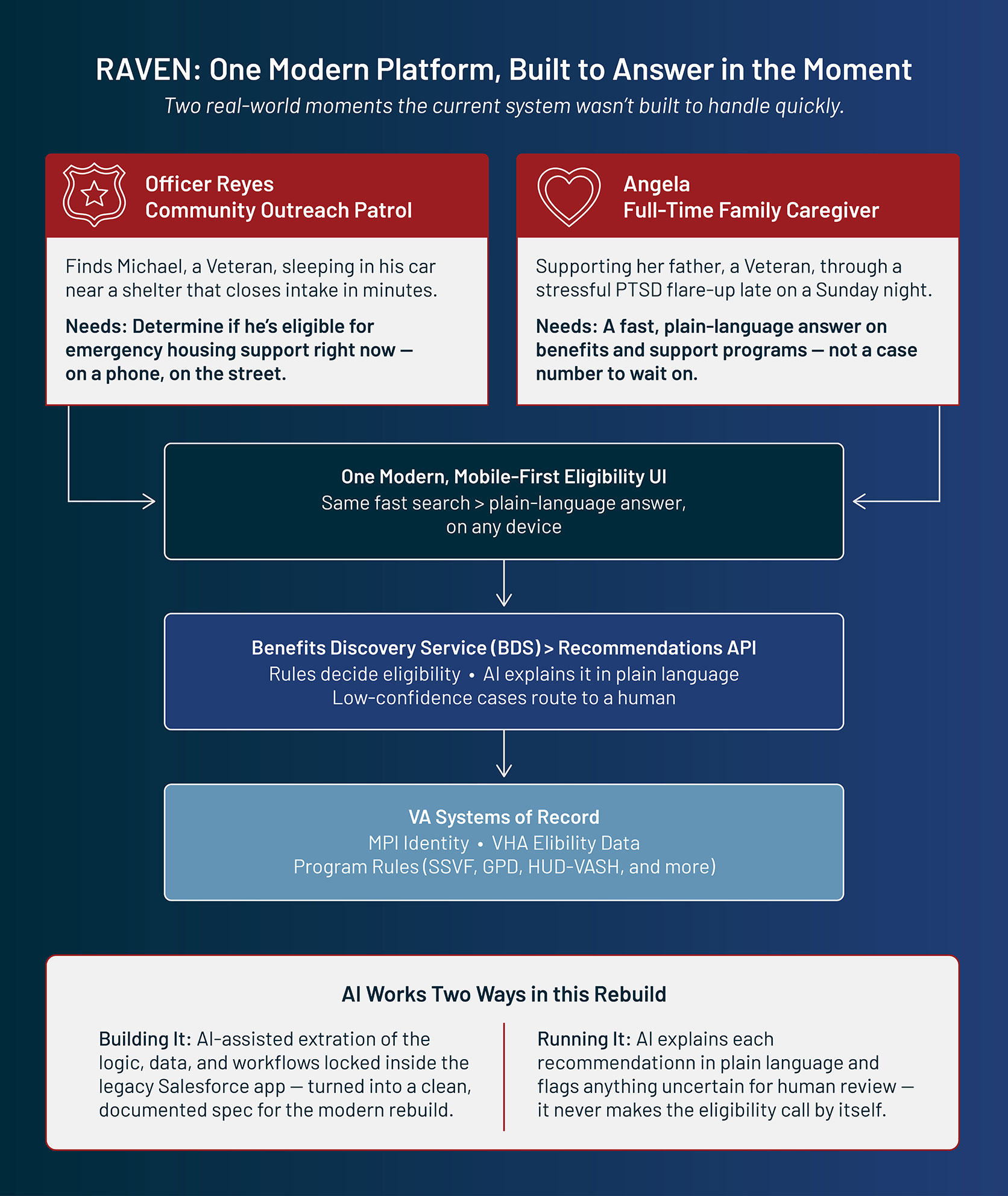
It’s 11 p.m. on a Sunday. Angela has been up since dawn helping her father get through a hard night with his PTSD — he’s a Veteran, and tonight is a difficult one. Somewhere between calming him down and calling her sister for backup, she tries to find out, fast, what support programs he actually qualifies for. What she gets back is a login screen, a case number, and a promise that someone will follow up.
A few miles away, Officer Reyes is doing a welfare check on a man sleeping in his car near a shelter. His name is Michael. He’s a Veteran. The shelter stops taking new arrivals for the night in twenty minutes, and Officer Reyes needs one thing: Is this man eligible for emergency housing support right now, from her phone, on the street?
Different people, different nights, same failure point.

The system behind both of those moments — VA’s SQUARES eligibility platform — was built years ago on Salesforce, and it wasn’t designed for a phone in a patrol car or a caregiver at a kitchen table at midnight. It was designed for a caseworker at a desktop. That gap is exactly what VA’s RAVEN initiative exists to close: rebuilding how Veterans, caregivers, and the people supporting them get a fast, trustworthy answer about benefits eligibility.
We’ve spent the last several weeks doing the unglamorous work that makes a rebuild like this credible instead of theoretical. Our team has been getting hands-on with three things RAVEN actually demands: pulling the real logic, data, and workflows out of a Salesforce-style system instead of guessing at what’s in it; proving out our approach to building against VA’s Lighthouse platform and its Benefits Discovery Service (BDS) API, the recommendations engine behind eligibility answers; and designing a mobile-first UI that works as well for a caregiver on a phone at midnight as it does for an outreach officer standing on a sidewalk.
That third piece matters more than it sounds like it should. A lot of modernization projects treat the interface as the last 10%. For the people in the two moments above, the interface is the product. If the answer doesn’t arrive in under a minute, in plain language, it doesn’t matter how good the API behind it is.

Here’s where AI comes in — and we’re being specific about this because “AI-powered” gets thrown around loosely in this space, and VA has been explicit that it wants AI that is bounded, explainable, and never making high-stakes decisions on its own.
We’re building it in two distinct ways:
First, in how we build the system.
Migrating years of accumulated Salesforce logic — objects, workflows, and business rules — into a modern, API-first architecture is exactly the kind of extraction-heavy, pattern-matching work AI is good at accelerating. Used deliberately, it turns weeks of manual reverse engineering into a documented, reviewable spec that our engineers validate before anything gets built on top of it.
Second, in how the system runs.
Once eligibility is determined by deterministic rules against authoritative VA data, AI’s job is to explain the result in plain language — why someone qualifies, what’s missing if they don’t, and what to do next — and to flag anything uncertain for a human to review. It never makes the eligibility call by itself. That’s not a compliance checkbox for us; it’s the only version of this that Officer Reyes or Angela can actually trust in the moment they need it.
We’re also not skipping the part of this work that’s easy to wave at and hard to actually do: VA has real, non-negotiable requirements around Zero Trust security, identity verification, and — especially — how AI is documented and governed before it ever touches a Veteran’s data. We’d rather build to that standard from day one than bolt it on later. A platform that’s fast but not trustworthy isn’t actually solving Angela’s problem or Officer Reyes’s — it’s just moving the failure point.
None of this is theoretical for us. Over the past few weeks, our team has been standing up a working proof of concept — extracting logic from a Salesforce-style surrogate system, standing up a mock recommendations API against a real API contract, and building the first slice of that mobile-first experience — specifically so we’re not showing up to this conversation with slides. We’re showing up with something we’ve already tried to break.
We don’t think modernizing a system like this is about replacing Salesforce with something shinier. It’s about making sure the answer gets to the person who needs it — a Veteran, a caregiver, an officer on patrol — before the moment passes. That’s the bar we’re building toward, and we’d welcome the conversation with anyone else who’s thinking hard about what it takes to get Veterans the right benefit at the right time, no matter which door they walk through.
The diagram below shows how those two scenarios and both uses of AI come together in one platform: a single mobile-first experience, backed by a BDS-style recommendations layer and grounded in VA’s systems of record.