
Modernize Without Disruption
Maintain Readiness. Accelerate Modernization. Deliver Mission Capability.
A practical approach to sustaining today’s Army technology environment while continuously delivering secure, modern capabilities for tomorrow.
Army modernization cannot come at the expense of today’s mission. Applications, SharePoint sites, workflows, databases, reports, and custom solutions support the workforce every day. At the same time, the Army needs greater automation, stronger governance, better use of data, and faster delivery of new capabilities. The G4-TS requirement reflects that challenge by combining ongoing Knowledge Management Environment operations with Power Apps, Power Automate, Power BI, SharePoint Online, and new solution development.
The challenge is straightforward: maintain readiness today while modernizing at mission speed for tomorrow.
One Portfolio. Two Mission Priorities.
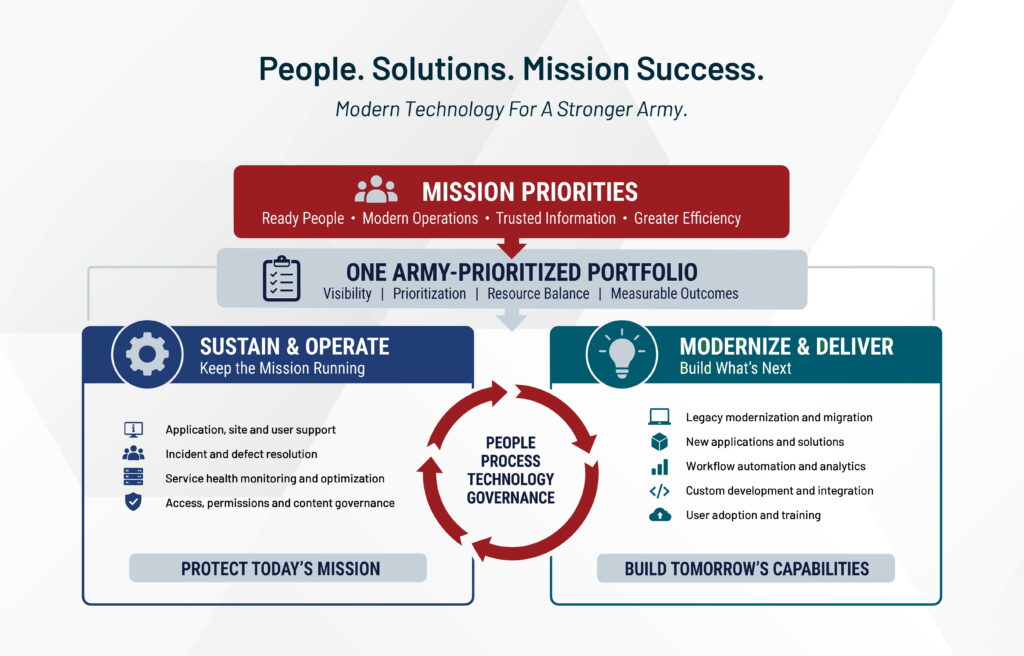
A practical approach is one Government-prioritized portfolio with two protected delivery lanes. Sustain & Operate keeps production capabilities running, resolves incidents and defects, manages access and content, and protects service health. Modernize & Deliver provides dedicated capacity for legacy modernization, new applications, automation, analytics, integration, and technical-debt reduction.
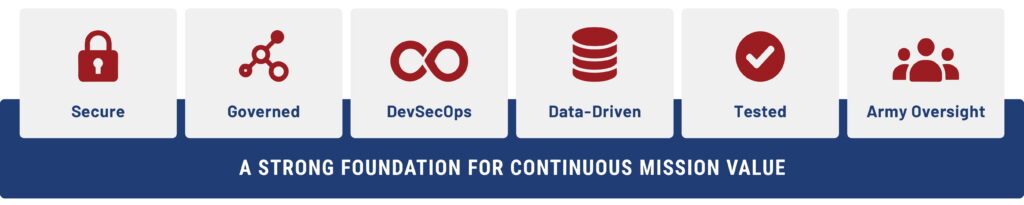
Common architecture, cybersecurity, DevSecOps, testing, data governance, and release controls connect the two. This protects operational continuity while allowing modernization to move forward at a sustainable tempo.
Modernize the Mission, Not Just the Technology
Modernization should start with the mission need. Before replacing a custom portal, file share, Access database, Excel/VBA solution, or other legacy capability, understand who uses it, what mission process it supports, what information it manages, what it connects to, and what happens if it fails.
Then make a deliberate decision: Retain → Remediate → Re-platform/Rebuild → Retire.
Where modernization provides value, SharePoint Online, Power Apps, Dataverse, Power Automate, Power BI, and custom development provide different tools for different mission requirements. Supporting Effort applies this approach for G4-TS through controlled modernization waves that include testing, data reconciliation, user acceptance, cutover, and eventual legacy retirement. The objective is to apply the simplest authorized solution that delivers the required mission capability.
Secure, Connected, and Governed
Speed without governance creates risk. As development accelerates, the Army needs visibility into what applications exist, who owns them, what information they use, who can access them, what systems they connect to, and how they move into production. Security and governance must therefore be engineered into the delivery lifecycle.
Integration is equally important. Modern applications depend on authoritative systems, APIs, identity, data, and business rules. Supporting Effort applies this discipline today in Federal environments, including integration capabilities under VA VEMSIS that connect business applications with authoritative systems using defined interfaces, service identities, validation, testing, and security evidence.
AI can provide another accelerator where authorized, by supporting requirements analysis, development, testing, documentation and other bounded engineering activities, while people remain accountable for mission outcomes. Engineers validate the work, security, and quality controls remain intact, and the Government retains acceptance and release authority.
Deliver Capability Continuously
Modernization should not be a one-time technology refresh. It should become a continuous mission-delivery cycle:
Measure → Prioritize → Sustain → Modernize → Validate → Release → Improve
Every release should leave the environment more supportable, secure, automated, measurable, and aligned with the mission.
At Supporting Effort, our experience across Microsoft Power Platform, Dynamics 365, Dataverse, SharePoint, Azure, automation, analytics, enterprise integration, DevSecOps, and Federal production sustainment reinforces a simple principle:

Maintain readiness. Accelerate modernization. Deliver mission capability.
The Army should not have to choose between keeping today’s mission running and building what it needs tomorrow. The right delivery model does both—securely, continuously, and at mission speed.